Summer Slide Activities: A Light Weekly Plan by Grade Band
You do not need worksheets to keep skills fresh over summer. Here is a light weekly plan for three grade bands, built on reading, games and everyday math.
The simplest way to avoid a summer slide is a short, steady routine of reading plus a few playful math moments, not a pile of worksheets. Aim for about 15 to 30 minutes of reading most days, add a few minutes of math through games and cooking, and use your public library for books and programs. Below is a weekly plan for three grade bands.
What “summer slide” means
Teachers often use the phrase “summer slide” for skills that get rusty over a long break from school. How much any one child is affected varies, so there is no need to panic. The aim is to help your child start the new school year feeling ready, while still having a real summer. This guide makes no promises about test scores. It focuses on habits that are easy to keep.
Set up your summer routine
- Ask the teacher. Find out what skills to practice, and look for any summer list on the school website.
- Pick a daily time. A fixed slot, such as after breakfast or during afternoon quiet time, makes it easy to follow.
- Keep sessions short. Fifteen to thirty minutes is enough. Stop if energy drops.
- Visit the library. Get a card for every family member and check out a weekly stack of books.
- Choose two or three habits. For example, daily reading, a weekly game night and one cooking project.
- Take weekends off. Rest is part of summer, and so is play.
Weekly plan by grade band
| Grade band | Reading (most days) | Math (2 to 3 days) | Weekly extra |
|---|---|---|---|
| Kindergarten to 2nd grade | Read aloud together, then let your child read a short book to you or a stuffed animal | Count coins, play board games with dice, measure ingredients, count steps to the mailbox | A library visit and a drawing of a favorite page |
| 3rd to 5th grade | 20 minutes of a chapter book, a graphic novel or an audiobook of choice | Card games for multiplication facts, double or halve a recipe, compare prices at the store | A postcard or letter to a relative, or a reading log entry |
| 6th to 8th grade | 20 to 30 minutes of independent reading, including magazines and nonfiction | Plan a small budget for an outing, track sports statistics, work out the cost per ounce | One paragraph about something they learned or a short project, such as planning a trip |
A sample week
- Monday: Library day. Each person picks books, and the child checks out a few of their own.
- Tuesday: A math game after lunch, such as dice or cards.
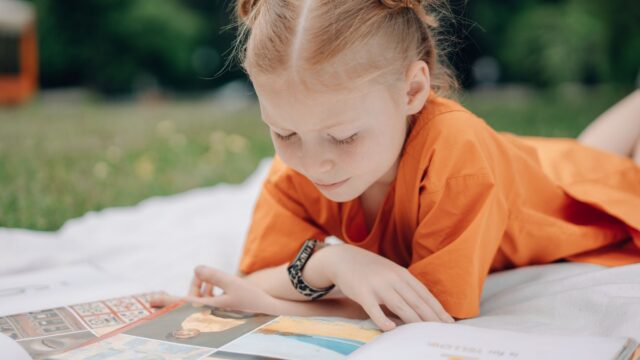
- Wednesday: Reading outside, with a picnic blanket or a shady chair.
- Thursday: Cooking day. Let your child measure and read the recipe.
- Friday: Write or draw a short entry in a summer journal, then play.
Reading ideas
- Sign up for the library’s summer reading program, which is free at many libraries. See our guide to a summer reading challenge for tracker ideas.
- Read a book that has been made into a movie, then watch it and compare.
- Take turns reading aloud in the car. For picks by age, try our read-aloud books list.
- Read about places you plan to visit.
- Start a family book club, even with only two people.
Math ideas for everyday life
- Cooking: Fractions, measuring and timing.
- Shopping: Estimating the total, comparing sizes and finding sale prices.
- Games: Cards, dice, dominoes and board games. Our math games at home are quick to learn.
- Money: A lemonade stand or savings jar.
- Sports: Keeping score and statistics.
- Building: Measuring for a fort or a garden plot.
Writing and curiosity ideas
- Keep a summer journal or photo diary.
- Write postcards or emails to grandparents or friends.
- Make a list for the next camping trip or outing.
- Write a short story, comic or puppet-show script.
- Follow a question, such as “How do bees make honey?”, to the library or a museum.
Other ways to add structure to the break: try a week of summer camp at home.
On travel and busy days
- Pack a few paperback books or download audiobooks before a road trip or flight.
- Count a “mini session” of five minutes of reading before bed as a win.
- Turn waiting time into a license-plate game, a spelling game or a mental math game.
- If you miss a week, restart without guilt.
Keep it light
- Offer choices. Children stick with routines they helped design.
- Count real-life learning, such as museum visits, nature walks and cooking.
- Avoid turning every activity into a lesson.
- If your child is struggling with reading or math, talk to their teacher. For concerns about learning or development, your pediatrician can also help.
Bottom line
A summer routine can be small. Read most days, play a math game a few times a week, use the library and keep sessions short. Choose what fits your child’s grade band, check in with the teacher and leave plenty of time for fun.
FAQ
How much should a child practice in summer?
There is no set rule. A light routine of 15 to 30 minutes of reading on most days, plus a few math activities each week, is a reasonable starting point.
Do we need workbooks?
Not necessarily. Games, cooking, reading, writing postcards and everyday math can cover the same skills. Some families like a workbook, and that is fine if your child enjoys it.
What if a child resists?
Shorten the session, offer choices and move it to a better time of day. Ten happy minutes about a favorite topic is a better start than an hour of struggle.
When should we start?
Start in the first week of break, after a few days of rest. Build the routine slowly, and keep it going through the end of summer.