Math Games at Home: Quick Practice With Cards, Dice and Measuring Cups
Math practice does not need worksheets. A deck of cards, a pair of dice and a measuring cup are enough for games from kindergarten to middle school.
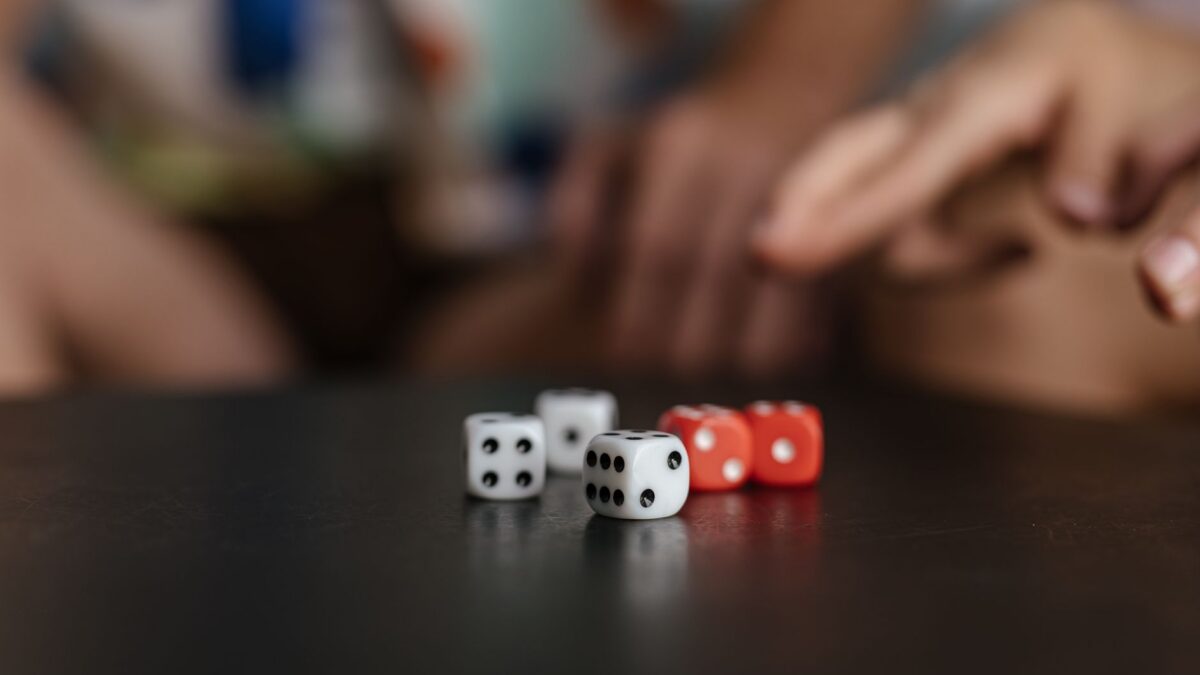
You can practice math at home without worksheets using a deck of cards, a pair of dice, coins and the kitchen. Pick a game that matches your child’s grade, play for 10 to 15 minutes and talk about how your child got each answer. Short, frequent, playful rounds work better than a single long session.
Games at a glance
| Game | Grades | Supplies | Skill |
|---|---|---|---|
| Number War | K to 1 | Deck of cards | Comparing numbers |
| Dice Add and Cover | K to 1 | Two dice, paper | Adding within 12 |
| Make Ten | K to 2 | Deck of cards | Number pairs to 10 |
| Addition War | 1 to 3 | Deck of cards | Addition facts |
| Race to 100 | 2 to 3 | One or two dice, paper | Adding, place value |
| Coin Shop | 2 to 3 | Coins, price tags | Counting money, making change |
| Array Capture | 3 to 4 | Two dice, graph paper | Multiplication, area |
| The 24 Game | 4 to 6 | Deck of cards | Operations, mental math |
| Recipe Fractions | 4 to 6 | Measuring cups, a recipe | Fractions, scaling |
| Two-Dice Probability | 6 to 8 | Two dice, tally sheet | Probability, data |
| Unit Price Detective | 6 to 8 | Store flyer or a trip to the store | Ratios, unit rates, percent |
Kindergarten and first grade
Number War
Remove the face cards from a deck. Each player flips one card, and the higher number wins both cards. When the cards match, flip again. Ask “How many more?” to practice subtraction.
Dice Add and Cover
Write the numbers 2 through 12 on paper. Roll two dice, count the dots (or add them) and cover that number with a coin. Play until you cover a row or run out of rolls.
Make Ten
Remove the 10s and face cards (Aces count as 1) and deal 5 cards to each player. Take turns asking for a card that adds to 10 with one in your hand, like Go Fish. Make as many pairs as you can.
Second and third grade
Addition War
Each player flips two cards and adds them. The higher sum takes all four cards. To practice subtraction, find the difference instead. For multiplication facts, flip two cards and multiply.
Race to 100
Roll one die and add the number to a running total. For more challenge, roll two dice and make a two-digit number, like 3 and 5 as 35 or 53. The first player to reach exactly 100 wins. Or start at 100 and race down to zero.
Coin Shop
Put prices on a few household items, such as 25 cents for a toy. One child is the shopkeeper, and another is the customer who pays with coins and checks the change. Swap roles after a few turns.
Fourth and fifth grade
Array Capture
On graph paper, roll two dice and draw a rectangle with those dimensions, for example 4 by 6. Write the multiplication fact inside and color it. Take turns filling the page. The player with the most squares colored when no more fit wins.
The 24 Game
Remove the face cards and deal four cards. Using each card exactly once with addition, subtraction, multiplication and division, make the number 24. For example, 1, 2, 3 and 4 make 24 by multiplying them all together. A tougher puzzle: 3, 3, 8 and 8 work with 8 divided by (3 minus 8 divided by 3). Start with easier combinations and let kids work in pairs.
Recipe Fractions
Pick a simple recipe and double or halve it. Ask “How many one-fourth cups make one cup?” and “What is half of three-fourths?” Use real measuring cups to check the answer, then eat the result.
Estimation Jar
Fill a jar with a countable item, like cereal or buttons. Each player writes an estimate. Count together and find the difference between each guess and the real number.
Middle school (sixth to eighth grade)
Two-Dice Probability
Before rolling, predict which sum will come up most often. Roll two dice 36 times, tally the sums and compare. Then list all 36 possible combinations: six of them make 7, which is why 7 is the most likely sum. Repeat with 100 rolls and compare the results to the predictions.
Unit Price Detective
At the store or with a flyer, compare two sizes of the same product. Divide the price by the amount to find the unit price, and decide which one is the better deal. Add a sale: if it is 25 percent off, what is the new price?
Card Sum Challenge
Play a card game where the goal is a total as close to 21 as possible without going over. Play with points, not money. After each game, talk about which draws were risky and why.
Scale It
Draw a floor plan of a bedroom on graph paper using a scale such as one square for one foot. Measure the room and furniture and see what fits.
How to make math games work
- Keep it short. Ten to fifteen minutes is plenty. Stop while it is still fun.
- Ask “How did you know?” Explaining a strategy builds understanding more than getting the right answer.
- Adjust the level. Use smaller numbers if it is frustrating and larger numbers or extra rules if it is too easy.
- Let kids run the game. The dealer, banker or scorekeeper role gets extra practice.
- Win and lose gracefully. Talk about it. Cooperative versions, where the family tries to beat a target together, can help kids who dislike losing.
- Link to real life. Cooking, shopping and sports scores are daily math practice.
- Play with points, not money. Keep games about the math, not betting.
- Mind small parts. Dice, coins and counters can be choking hazards for children under 3 and any child who still mouths objects.
Looking for more ways to turn games into a habit? See our family game night ideas, which include card and paper games that cost nothing, and our road trip games, many of which work for number practice in the car. For a light daily routine over break, our summer slide activities include math ideas, and our homework routine guide can help you pair games with study time.
Bottom line
A deck of cards, two dice and a kitchen are enough for a year of math games. Choose by grade, keep sessions short, ask your child to explain their thinking and stop while it is still fun. If math is a persistent struggle, talk with your child’s teacher about what to focus on.
FAQ
How often should we play math games at home?
A few short sessions a week are a good start, even if each is only 10 minutes. Regular, low-pressure practice is easier to keep up than a long weekend session.
Do games replace homework or school instruction?
No. Games are a supplement. They add low-pressure practice and show your child that math shows up in daily life. Follow your child’s teacher for what to focus on.
What if my child hates math?
Start with a game that has little writing and lots of fun, like dice or cards. Praise effort and strategy, and let your child choose the game. If anxiety is high, talk with your child’s teacher.
Are online math games better than hands-on ones?
Not necessarily. Hands-on games give kids a chance to talk, move and play with family. Some online games are useful too, so choose quality ones and set time limits as part of your family’s plan.